English
 русский
 Español
 italiano


Large porcelain tiles are changing the demands placed on installation and handling equipment. A panel may be long, heavy, and difficult to grip around the edges, making suction cups for porcelain tile a practical tool for lifting, positioning, and adjusting the material.
Security, however, is not determined by suction alone. Tile surface condition, cup diameter, vacuum type, load distribution, and the number of contact points can all affect how securely a porcelain tile is held. Current large-format systems range from individual 120 mm cups with capacities around 40 kg to multi-cup handling frames designed for much heavier slabs.
A larger porcelain tile does not simply require a stronger handle. As panel dimensions increase, the material can become more difficult to control during lifting and positioning. Long slabs may flex or twist, placing uneven stress on both the tile and the suction points.
Specialized installation guidance therefore recommends handling frames with multiple suction cups for large-format slabs. Depending on the tile size, systems may use four suction cups or two double cups to distribute the load across a wider area.
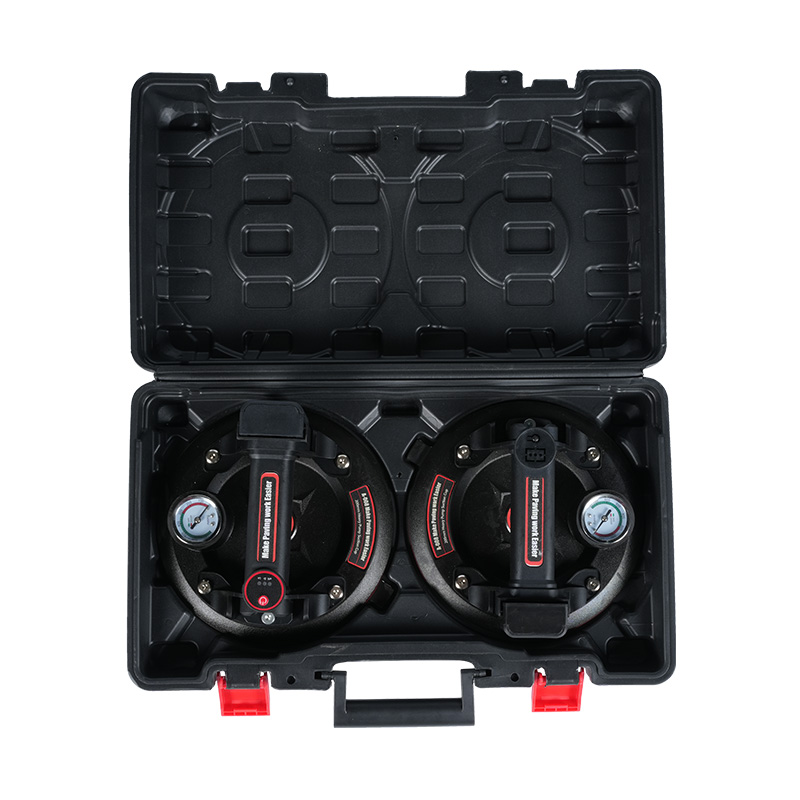
Porcelain is often regarded as a suitable material for vacuum handling, yet surface finish still matters. Smooth, flat, clean, and non-porous surfaces generally provide favorable conditions for conventional vacuum cups. Dust, loose particles, moisture, and surface irregularities can interfere with the seal between the rubber pad and the tile.
Some suction cups for porcelain tile are specifically designed for rough or lightly textured surfaces. Products in this category may use specialized rubber compounds or larger vacuum pads to maintain contact where conventional smooth-surface cups have limitations. Examples on the market include 200 mm vacuum cups rated around 130 kg for rough or textured large-format porcelain.
A single cup can be useful for lifting, positioning, or making small adjustments to a compatible tile. Larger professional models often use an 8-inch, or approximately 200 mm, vacuum pad. Published lifting capacities vary significantly by design; examples include products rated at 110 kg, 129 kg, or higher.
Capacity figures should not be treated as the only consideration. The actual tile weight, handling direction, surface condition, and manufacturer instructions all influence practical use.
Double-cup designs increase the contact area and can offer greater control when handling heavier tiles. Bellota, for example, lists a 120 mm double-cup design with a stated holding capacity of 70 kg, compared with 40 kg for its single-cup version.
Two contact points may also help reduce unwanted rotation while installers carry or position rectangular tiles.
Extra-large porcelain panels create another level of demand. A handling frame can combine several suction cups with aluminum rails, adjustable crossbars, and dedicated lifting handles. Such systems are designed to support the tile across a broader area rather than concentrating control at a single point.
Manual and electric vacuum systems can include indicators that show changes in suction pressure. A red-line indicator, pressure gauge, or similar visual signal allows the user to monitor vacuum integrity during handling. QEP, for example, offers an 8-inch pump suction cup with a 0–760 mmHg safety gauge and a stated 285 lb lifting capacity.
This feature becomes especially useful during longer handling operations because a visual indicator can reveal a reduction in vacuum before the tile is moved further. Pump-operated cups may also allow the vacuum to be restored during use, which is an advantage highlighted in large-format tile installation guidance.
Buyers comparing suction cups for porcelain tile can look beyond the advertised lifting capacity and review several product details:
Reliable handling depends on the complete connection between the tool and the porcelain surface. Clean contact areas, appropriate cup design, sufficient load capacity, and balanced positioning all contribute to a secure hold. Installation guidance for large-format porcelain also emphasizes cleaning the tile face and suction pads before use and using specialized frames or multiple suction points as slab dimensions increase.
Large porcelain tiles can therefore be handled securely with the right suction cups for porcelain tile, but the answer is not simply to choose the cup with the largest capacity number. Surface texture, cup configuration, vacuum monitoring, and load distribution deserve equal attention. As tile formats continue to grow, multi-point support and controlled vacuum handling become increasingly relevant to safe and stable installation.
Copyright © Yongkang Shuofang Import and Export Co., Ltd. All Rights Reserved.

Falans Tile Laying Tools Factory